
The China Tea Marketing Association (CTMA)
The China Tea Marketing Association (CTMA) was found in 1992

The China Tea Marketing Association (CTMA) was found in 1992
“Qianliang Tea” is a highly representative product within the dark tea family, with its production technique originating from Anhua County, Yiyang City, Hunan Province. In the first year of the Daoguang reign during the Qing Dynasty (1821), local tea merchants bundled the dark tea into small cylindrical blocks for easier transportation, with each block weighing 100 liang; by the second year of the Tongzhi reign (1863), the weight was increased to 1,000 liang, giving rise to the name “Anhua Qianliang Tea.”

The uniqueness of the Qianliang tea processing technique lies not in “production” but in “refining” —it demands advanced technical expertise and involves substantial labor intensity, comprising a total of 23 steps. The production process consists of two stages: black tea processing and deep processing. Black tea processing includes five steps: fixation, rolling, piling, re-rolling, and baking; whereas the deep processing stage is far more complex, encompassing a series of steps such as screening, blending, softening, basket packing, pressing, binding with hoops, sealing, cooling, and drying.
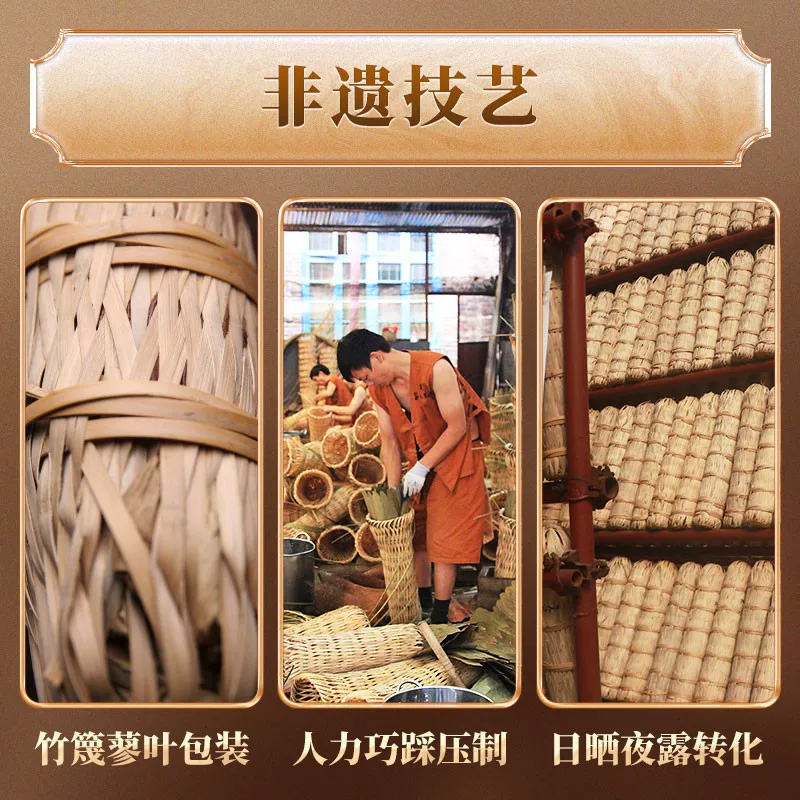
The craftsmanship of making Qianliang tea was inscribed on the second batch of the National Intangible Cultural Heritage List in 2008.
